

A lower tax bill can still leave someone with less flexibility. A bigger business sale can still produce a smaller retirement fund than expected. And money given away to help the next generation is money no longer available for your own future. The interesting Budget question is not simply who pays more, but which decisions look different once the trade-offs are put alongside each other.
But once the Chancellor has sat down and the headlines have settled, the question I’m always interested in is a much simpler one: what does this actually mean for people and the financial decisions they’re making?
Whether you’re building a business, planning retirement, helping your children onto the property ladder or simply trying to make your money work harder, it’s rarely one Budget announcement that makes the biggest difference. It’s how all the changes fit together.
For each area below, there are three questions: what has changed, what difference could it make, and what might be missed by looking at tax alone? The aim is to examine the trade-offs, not to prescribe the same answer for everyone.
1. Business owners: a different picture depending on how you built your business
One of the most interesting announcements is the introduction of Founders Relief. From April 2027, qualifying founders of high-growth, innovative companies could benefit from a 10% Capital Gains Tax rate on up to £10 million of lifetime gains. The precise eligibility rules are still being consulted on.
At the same time, the government is halving the lifetime limit for Business Asset Disposal Relief (BADR) from £1 million to £500,000, with the qualifying tax rate remaining at 18%.
And this is where things get interesting. Not everyone who builds a successful business founded it. Some people buy existing businesses, turn around struggling companies or spend decades growing a family business. They take risks, employ people and contribute to their communities. Yet two owners selling businesses for similar gains could potentially face very different tax bills.
The Treasury expects three-quarters of BADR claimants still to receive relief on their entire qualifying gain. But for owners selling more valuable businesses, the impact could be considerable. We should encourage start-ups while also recognising those who buy, build and grow existing businesses.
An illustrative £1 million gain shows why eligibility matters more than the headline sale price. At the proposed 10% Founders’ Relief rate, tax would be £100,000. With £500,000 qualifying for BADR at 18% and the remaining £500,000 taxed at an assumed 24%, tax would be £210,000. With no relief and the whole gain taxed at an assumed 24%, it would be £240,000. These are alternative examples, not interchangeable choices: they assume full eligibility where stated, no previous use of the relevant lifetime limit, no losses, no annual exempt amount and no transaction costs. Founders’ Relief remains subject to consultation and legislation.
And remember: for many owners, their company is effectively their retirement fund. What they keep after tax, and how that money supports their future, matters just as much as the sale price.
2. Savings and property income: another tax increase
Last year’s Budget had already announced an additional two percentage points of tax on savings and property income from April 2027. This Budget has added another two points on top. The relevant basic, higher and additional rates will therefore be 24%, 44% and 49%.
For landlords dealing with borrowing costs and maintenance, that could further reduce the income they retain. For savers holding significant cash outside tax-efficient accounts, the tax treatment of interest deserves attention. Not everyone will be affected: savings allowances and tax-free wrappers remain relevant.
For every £10,000 of income fully exposed to the stated savings or property income rates, the previously announced 22%, 42% and 47% rates would leave £7,800, £5,800 and £5,300 after tax. At 24%, 44% and 49%, those amounts become £7,600, £5,600 and £5,100. The additional two-percentage-point increase therefore costs £200 in each example. These figures ignore allowances and assume the whole £10,000 falls within one tax band; property income means taxable profit, not gross rent.
It’s not just how much return your money generates. It’s how much of it you actually get to keep.
3. Cash ISAs: some welcome certainty
The government has reversed its earlier decision to reduce the Cash ISA limit to £12,000. The £20,000 annual ISA allowance remains in place.
The more useful question is what the money is for, and when it will be needed. Emergency funds, house deposits and planned expenditure raise different questions from money intended for the distant future. Keeping cash avoids investment-market fluctuations, but inflation can reduce its purchasing power. Investing introduces the possibility of losses, including when the money is needed. A tax-free wrapper does not remove that distinction.
The government is also exploring an incentive for first-time Stocks and Shares ISA investors. The detail is still to come. In retirement, ISA withdrawals are generally free of income tax, making them a useful complement to pensions rather than necessarily an alternative.
4. Pensions and inheritance tax: the bigger changes are still coming
One of the most important retirement planning changes wasn’t newly announced today. From April 2027, most unused pension funds and pension death benefits will be brought into inheritance tax calculations.
For years, families have often spent other assets first and preserved pensions for the next generation. That strategy may need reconsidering. But there’s an important word there: may.
Taking pension money out simply because it could face inheritance tax isn’t automatically the answer. A withdrawal can create an income tax bill now, remove funds from the pension’s tax-efficient environment and still leave the money in the estate for inheritance tax purposes.
Three questions sit behind the pension debate. Leaving money in the pension preserves its existing tax environment but does not remove the announced inheritance tax issue. Withdrawing and keeping the proceeds can create income tax now while leaving the remaining cash in the estate. Withdrawing and gifting adds another question: what resources and flexibility has the donor given up? A meaningful comparison must use the same starting pension value and account for withdrawal tax, estate treatment, gift rules and future spending needs rather than compare headline tax rates alone.
For some families, earlier withdrawals or lifetime gifts may be worth exploring. For others, keeping the pension invested may still be appropriate. The real question is how income tax, inheritance tax, retirement income and longevity work together — and whether you can afford your plans without compromising your own security.
5. The State Pension: changes to the triple lock
The Budget confirmed an adjusted State Pension triple lock from April 2030. Pensions will still rise annually, but the mechanism will track earnings more closely over time. The Treasury estimates a £15 billion annual reduction in State Pension expenditure by the late 2030s.
A purely mathematical illustration shows why small annual differences matter. Starting with £10,000 a year, increases of 2% would produce annual income of about £16,406 after 25 increases; increases of 3% would produce about £20,938. The difference is about £4,532 a year at that point. These are nominal amounts before tax, with no inflation adjustment. Neither growth rate is a State Pension forecast or a calculation of the announced triple-lock change.
The State Pension remains an important foundation, but small differences in future increases can add up over 25 or 30 years. Retirement plans should consider a range of income and inflation scenarios, rather than one set of assumptions.
6. First-time buyers: help, but understand the detail
The Lifetime ISA is set to be replaced by a First Time Buyer ISA from April 2029. The announced framework includes up to £4,000 of annual contributions and a 25% government bonus, with detailed arrangements and transition rules important for existing savers.
The Your First Home equity-loan scheme is intended to support qualifying first-time buyers purchasing new-build homes with deposits as low as 2.5%. That support may be valuable, but an equity loan also means future repayment obligations.
The question is not only whether a smaller deposit makes a purchase possible. It is also what the mortgage and equity-loan obligations could mean later, how repayments are calculated, and what happens if circumstances change. For family members providing help, there is a separate comparison: the benefit to the buyer against the effect on the donor’s own future resources.
We’re also seeing more conversations about parents and grandparents helping younger family members. A deposit gift can fit alongside wider family and estate planning — but should never undermine the donor’s own retirement or future care needs.
7. Household costs: some breathing space
Up to 20 million households in England in council tax bands A–D will receive a £100 energy payment from January 2027, with funding for devolved governments. The temporary VAT reduction on domestic electricity has been extended, and the fuel duty cut continues until July 2027.
A £100 payment can make a real difference to an immediate bill. It is not the same as a recurring reduction in expenditure, however. The longer-term question is whether regular income covers regular spending once temporary support ends. That distinction matters both to households managing today’s costs and to anyone estimating what retirement will cost.
So, what hasn’t changed?
There were no new increases to the headline rates of income tax on earnings, National Insurance or VAT. The £20,000 overall ISA allowance remains. This Budget did not announce a new general reduction to the pension annual allowance or pension tax-free lump sum.
But existing measures haven’t disappeared: pension inheritance tax changes are still scheduled for April 2027, and previously announced pension salary-sacrifice restrictions remain relevant. Frozen personal tax thresholds also mean more income can become taxable as salaries and pensions rise, even without a headline rate increase.
So a freeze is not necessarily a standstill. If income rises while a threshold stays fixed, what happens to the amount left after tax—and does it buy any more once prices have risen?
My biggest takeaway
If there’s one thing this Budget reinforces for me, it’s that financial decisions can’t be looked at in isolation. A pension decision affects inheritance tax. Pension contributions can affect income tax and family benefits. ISAs offer retirement flexibility. Selling a business creates retirement and estate-planning decisions. And helping younger generations must be balanced with what you might need later in life.
The most revealing comparison may be the one that looks beyond the tax bill: how much is left, when is it available, what risks remain, and which choices become harder to reverse? If a decision looks attractive only when one of those questions is left out, the headline has not told the whole story.
That’s a far more useful conversation than simply deciding who won or lost from the Budget.
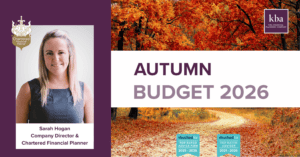
Sarah Hogan FPFS | Chartered Financial Planner, KBA Financial
This article explores Budget announcements and the questions they raise; it does not recommend a product, provider or course of action. It is general information, not personal financial or tax advice. Tax treatment depends on individual circumstances and may change. Some measures remain subject to consultation or legislation. Information reflects the position on 28 October 2026.
KBA The Financial Planning Company is a trade name of KBA FS Ltd, which is an appointed representative of The Openwork Partnership, a trading style of Openwork Limited, which is authorised and regulated by the Financial Conduct Authority.